
The Substance is a body horror fairy tale about our culture’s relentless obsession with youth and sex appeal. It is the second feature length film from writer-director Coralie Fargeat who broke onto the scene with her action thriller, Revenge. After her successful debut, Fargeat was offered to direct Marvel’s Black Widow, but declined to work within the studio system, knowing she would not have full creative control over the final cut. Instead she began working on the spec script for The Substance which after two years of writing finally began production in 2022.

It premiered at the Cannes Film Festival in May 2024 where Fargeat won Best Screenplay. The film became a sleeper hit once it made its theatrical debut, earning $77 million on a $17.5 million budget. Its success built organically from positive word of mouth as audiences and critics alike resonated with the film’s sharp social critique. This enthusiasm has translated into The Substance becoming an unlikely candidate this award’s season.

Elisabeth Sparkle, played by Demi Moore, is an aging actress whose career highs are in the rearview by the time we meet her. She’s the host of an aerobics television program which gets unceremoniously cancelled on the day of her 50th birthday. On the way home, she gets into a car accident and is rushed to the hospital. Fortunately, she comes out on the other side relatively unscathed, at least physically anyways. Once the doctor gives his stamp of good health, she is approached by a young nurse who informs Elisabeth that she would make a good candidate for a mysterious new treatment. He slips a USB in her pocket that is labeled “The Substance,” with a phone number attached. When she returns to her apartment, she plugs the USB into her TV and watches an advertisement for this experimental drug which promises that a new and better version of herself is within reach. Feeling like this must be too good to be true, she discards the USB.

However, she is haunted by feelings of irrelevance. Her acting awards only remind her of what she has lost and without her show on the air, there’s little to distract Elisabeth from reality. She has placed her entire self worth in her career and appearance, and without that external validation she struggles to find purpose in the second act of her life. Vulnerable and easily seduced by the promise of youth and beauty, she pulls the USB out of the garbage and calls the number on the back. Elisabeth arrives at a hidden distribution center to pick up the substance. When she opens the package, she is presented with a series of steps and rules for using the drug. There’s an activator, bright green and alluring, that will begin the process. Once injected, a new version of herself emerges from within, splitting her back open down the middle.


The two share a consciousness, but only one can be active at a time and they are limited to seven days each. They must switch at the end of each week, or else both of their lives will be in jeopardy. The younger version also needs to inject herself with stabilizer fluid each day to function. This fluid is extracted from Elisabeth’s back while she is out.

Desperate for a second chance at fame and adoration, Elisabeth ignores the clear danger in using this drug. Her double, played by Margerat Qualley, picks up where Elisabeth’s career left off, by auditioning to replace her on the morning dance program. Beautiful, bright eyed, and eager, this new self, named Sue, becomes an overnight success, skyrocketing to fame. As Sue’s life becomes increasingly more exciting and demanding, Elisabeth’s desires and personhood takes a backseat. The more time she spends in Sue’s body, the less concern she has for her own wellbeing. The two selves struggle with the limitations of their shared consciousness as Sue begins her hostile takeover.

The world of The Substance is adjacent to our own, reflecting back our most shallow desires. All of which is exaggerated to extreme lengths, burgeoning on absurdity, and with a complete lack of subtlety. This brash, in your face, pulp sensibility is a key aspect of the film’s identity. The cartoonish nature of Hollywood’s evil, the magic of the substance, Elisabeth’s single minded vanity, Sue’s reckless ambition, and of course the numerous and disturbing physical transformations all serve as metaphor and archetype first, reality second. The Substance stands defiantly in an era where studios and fans alike are demanding realism, lore consistency, and concise explanations of a film’s rules. It is a fable that rebukes those expectations and as such is an emotionally vivid and provocative thought experiment.
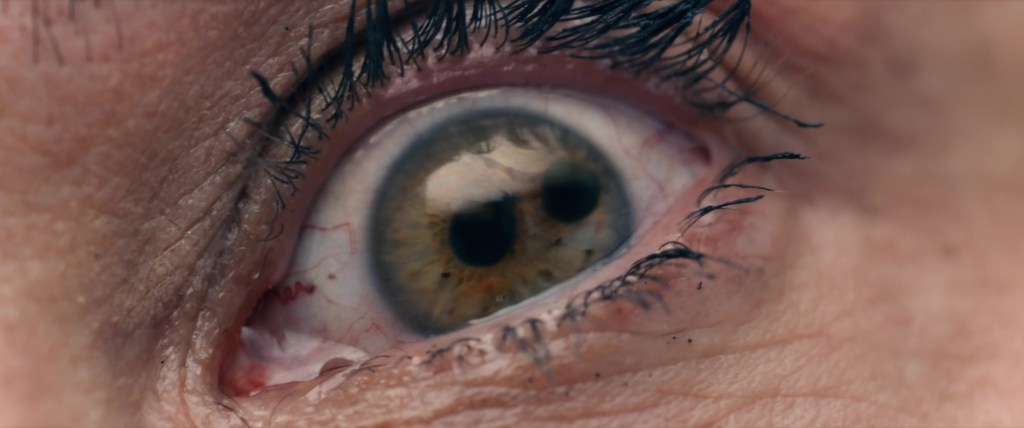
What would you sacrifice to achieve a better you? The black market drug is slipped to Elisabeth in secret by another user who claims that it changed his life. The substance is a stand-in for any number of designer drugs, legal or otherwise, whose danger and appeal are two sides of the same coin. The enticing green liquid promises to fix everything that is ailing Elisabeth and while she is warned to strictly adhere to the rules, the side effects are deliberately obscured. By the time she realizes her mistake, she is already hopelessly addicted to living vicariously through Sue. The disembodied voice over the phone reminds her time and again that she is in control and can stop the experience at any moment. So why doesn’t she?

Part of the reason is that the damage is already done. As Sue steals more time from Elisabeth, the effects on her body become permanent. There is no going back to how things were before she took the substance. Elisabeth already disliked her appearance to begin with, long before the effects of using manifested. Being stuck in this new body, alone, is worse than continuing to allow the situation to play out. Sue is also her only vehicle to experience being desired and celebrated. Once she ends the experiment, that feeling dies too.
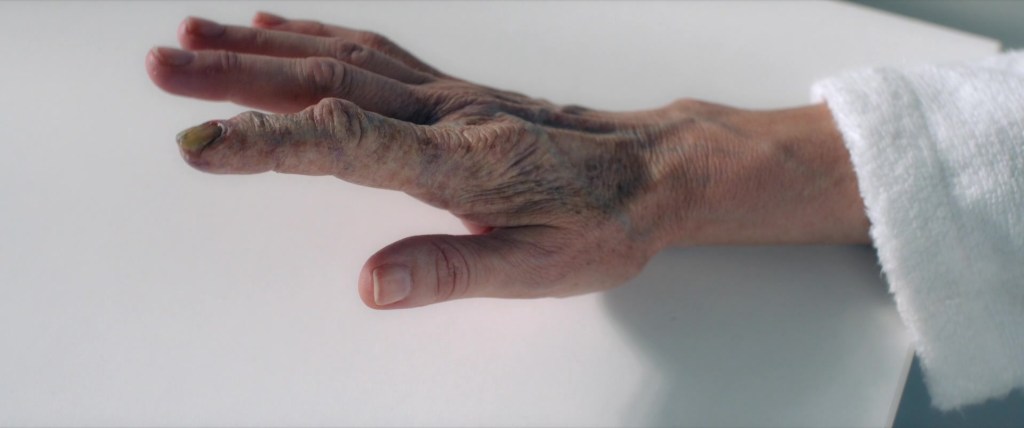
It is better for Elisabeth to be miserable for only half of her life than to sit with her disappointment and insecurities forever. In our world, it is common for celebrities to use drugs to cope with the stresses of being in the limelight. Addiction is often compounded once fame has fizzled, as people struggle to chase the highs of celebrity after their moment has passed. This has ended in countless tragedies that up until recently were treated as mere hazards of the job or dismissed entirely as individual moral failings.

The substance also represents the new wave of weight loss drugs championed by celebrities and marketed towards average people. Semaglutide injections have been used in treatments for some time, but the recent deployment as a weight loss cure has had sweeping consequences for our culture. The primary concern and skepticism comes from the nausea inducing side effects reported by users and not knowing the long term impact of these injections. Beyond that, their introduction comes at the tailend of a briefly lauded moment of body positivity in pop culture. The 2010s ushered in an era of backlash and criticism to the early 21st century’s cruel media landscape. The people who grew up reading grocery store checkout rags and listening to a steady stream of TMZ gossip, proudly rejected society’s ideal physical standards. Standards that would consider even the most attractive of A-listers as too fat to be showing off their bodies.

Any social progress achieved during this short-lived moment has seemingly vanished. As video based content is the main driver of engagement, physical appearance has possibly never mattered more. Especially for public figures whose output is limited to social media and therefore their brand is intrinsically linked to how they look on screen. Celebrities who once repudiated these impossible body standards are admitting to using weight loss injections. The primary narrative on the subject is now, “who would choose to stay fat when this option is available to them?” The issue is less about individual decisions, which would be an impossible task to police, but rather the cultural narratives forming around these drugs. As they become more commonplace and affordable, the pressure to use them will grow. If any of us are like Elisabeth, it will be a devastating realization to learn that your fears and insecurities are still there even after achieving your ideal body.

The unforgiving cycle of fame has been documented and commented on since the inception of the movie star. There’s a direct throughline from Sunset Boulevard to The Substance. Since stardom cannot last forever, it is worth examining what happens to individuals who must continue on after their time in the spotlight has ended. In the case of both films, the focus is on how an aging actress confronts her new reality. Harvey, the repulsive producer of Elisabeth’s show, fires her based on the idea that once a woman turns 50 years old, “it stops.”
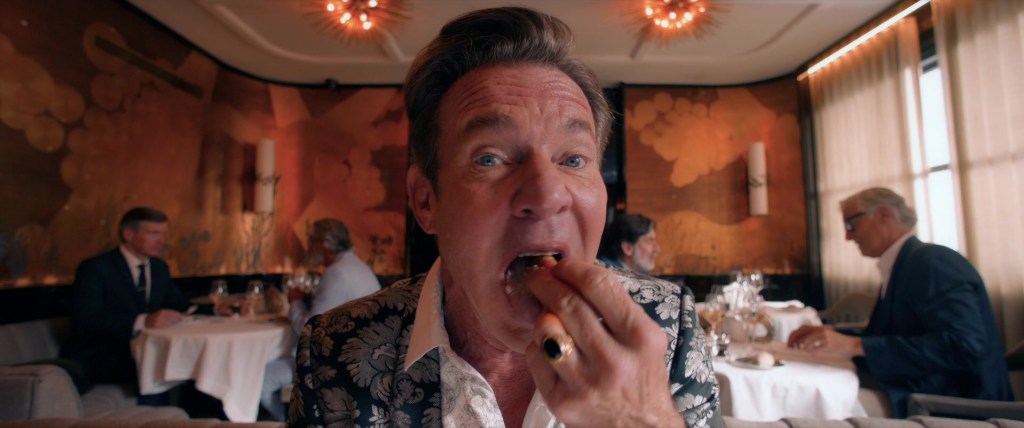
He does not elaborate, but the message is crystal clear. Women only have value to the industry so long as they can maintain their sex appeal well into middle age. Male producers, who hold power over the trajectory of an actress’s career, can make the executive decision to no longer provide employment. Their talent and onscreen charisma is secondary to their ability to elicit sexual desire within the imagined audience. Once the cheering and adoration has ceased, Elisabeth is left alone with her thoughts and regrets- still holding out hope that she can recapture some of that magic she felt at the start of her career.

This is juxtaposed with Sue’s remarkable rise and Harvey’s obsession with his newest muse. The rebooted program, “Pump It Up,” is a dance work out show, yet Sue’s audition doesn’t require any choreography. The casting agents involved simply comment on the physical appearance of each aspiring actress with little regard for their ability to perform well. When Sue cinches the starring role, it is entirely due to her flirtatious smile and form fitting bodysuit. This is what Harvey was looking for. There’s no exploration of Sue’s interiority or celebration of her ability. She is reduced to a pretty face and a gyrating butt on screen. But since the allure of fame is intoxicating, she has little interest in questioning her own overnight success. Her entire reason for existing spawned from Elisabeth’s desire to recapture what was lost. As a result, she does not have any other reason for living.

This all encompassing desire, shared by both, leads Sue to selfishly take more time than her weekly allotted amount. Sue justifies this insatiable need for notoriety by reminding Elisabeth that she, better than anyone else, knows how important it is to seize an opportunity when it’s presented. The pursuit of fame takes precedence over both of their well being. In fact, it may as well be the only thing that matters at all. Sue has an entourage of unspecified groupies and two nameless suitors throughout the runtime, but it is not like she’s using this fountain of youth to seek emotional attachments. No, her sex appeal is merely a tool to get ahead. It’s a shallow existence that is unsustainable, leading directly to their downfall.

By the time Elisabeth garners the strength to end this nightmare once and for all, it’s too late. Sue has taken everything from her so the only thing in life that matters is Sue’s success. With her upcoming New Years Eve show, Elisabeth couldn’t possibly end her life right before the moment they both worked so hard to get. Even as she is confronting the reality that Sue will stop at nothing to get what she wants, Elisabeth cannot let the dream die. She can’t bear to be left alone, in her apartment, withered to skin and bones, with nothing to show for it. So she lets Sue live and seals her own fate.

For most of The Substance, Sue and Elisabeth never meet. Their understanding of one another comes from dealing with the aftermath of their decisions. Sue resents Elisabeth for wasting her week stuffing her face in front of the TV when that time could be better suited for another photoshoot or red carpet premiere. While Elisabeth is outraged by Sue’s reckless behavior, that has had detrimental effects on her physical health and appearance. The pair represent this antagonistic relationship with the self that I think exists within all of us.

The customer service line chides them both, “remember there is no she and you. You are one. Respect the balance.” Neither are willing to concede though. The younger self has little regard for the older self, as exemplified by Sue’s misuse of the substance. This shortsighted, careless attitude, has a long term impact on the health of the older self. The more she abuses the stabilizer fluid, the more harm is inflicted upon Elisabeth. Her actions are done in pursuit of instant gratification with little concern for her own longevity. This is taken to the extreme when Sue eliminates Elisabeth without realizing that she needs her to live. An attack against Elisabeth is really an attack against herself.

In contrast, Elisabeth spends her days envious of what Sue has been given and lamenting her lost youth. She is so wrapped up in nostalgia and regret that she is unable to see that her life is not over just because she turned 50 years old. Instead of finding meaning elsewhere, she retaliates against Sue by overeating and making a mess out of their apartment. Elisabeth uses food as a weapon to drive the insecurities of the younger, more image focused self. After an evening of binge eating, Sue is subjected to a body horror delusion where she pulls a chicken drumstick out of her belly button. She is awoken to piles of discarded, partially eaten food, spread across the apartment. Knowing that Sue is driven by a concern for her own weight and body image, this is a deliberate attack.

Many of us treat our future self with as little regard as Sue treats Elisabeth. In most cases, this is not a malicious attempt to sabotage, but likely the result of short-term thinking. It is hard to imagine your own death, nevermind what middle age will look like when you are in your early 20s. Staying out all night, drinking, and using drugs may only result in a hangover the following day. A small price to pay for a good time. But what happens in the long run is given little consideration. The same can be said for spending your youth inactive and overindulging in fast food. What feels good in the moment can have a lasting impact on your future health, even if the consequences are not immediately felt.

It’s possible that something in our biology drives us to make these decisions based on impulse and instant gratification. However, our culture heavily encourages these indulgences as an important marker of youth and vitality. Our pop music, reality shows, and social media feeds overemphasize this attitude of “buy now, pay later.” Give into your superficial desires, consume everything you can, don’t think about tomorrow. The nagging self obsession that was once the territory of vain celebrities chasing youth, is now marketed to us all. Beyond the grotesque body horror of The Substance lies the real terror. If this vial of green existed in our world, individuals would not hesitate to inject themselves. In fact, they would be encouraged to do so by an army of influencers looking to sell the next “get hot quick” scheme.





 Reel Take
Leave a comment