
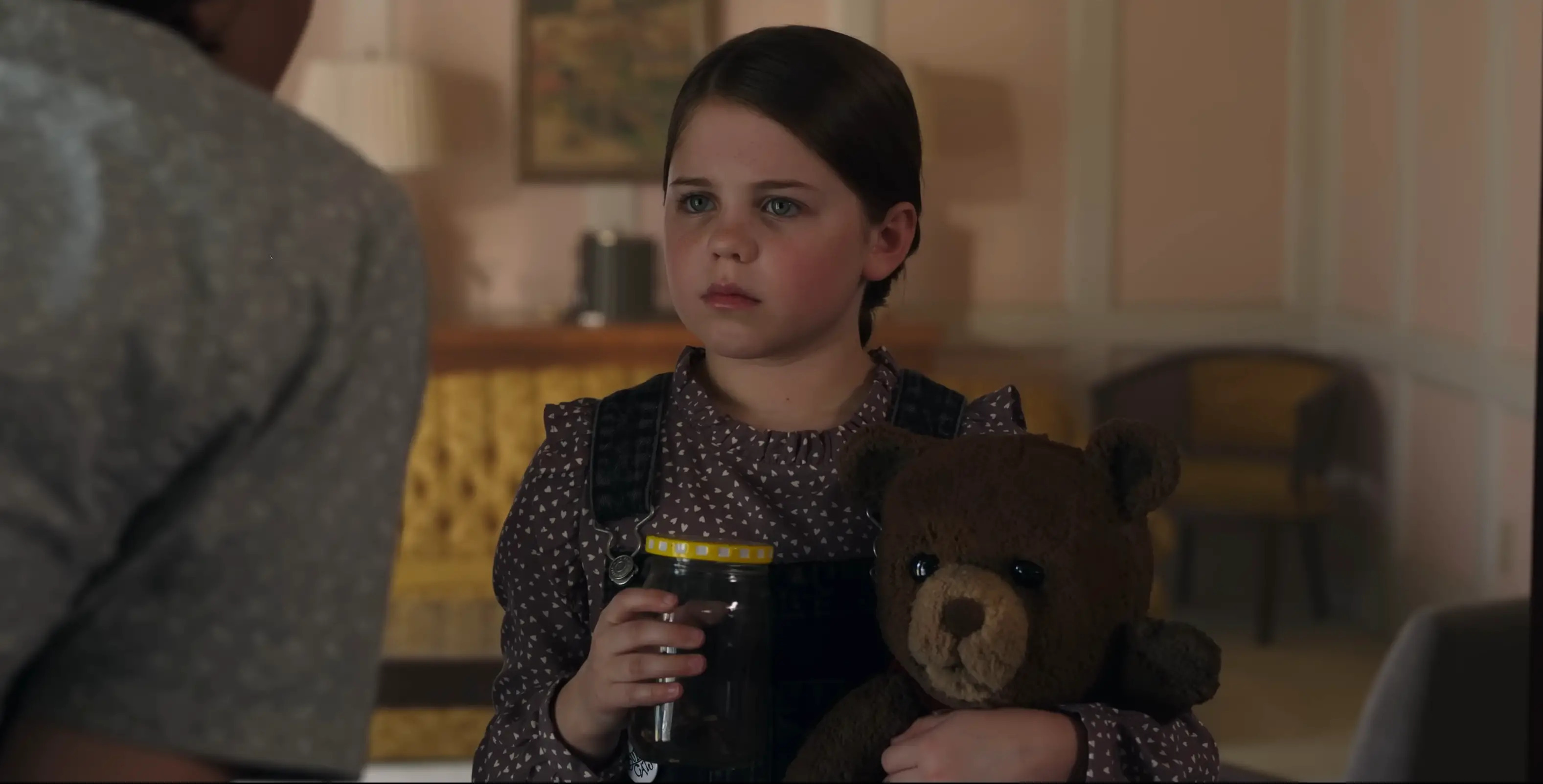
Imaginary is the latest nightmare to come from prolific horror creators, Blumhouse Productions. The film is a co-production with director Jeff Wadlow’s company, Tower of Babble Entertainment, and it is his third collaboration with the horror juggernaut. Imaginary stars DeWanda Wise as Jessica, an illustrator who moves back to her childhood home with her new husband and stepdaughters. The younger stepdaughter, Alice, finds an old teddy bear named Chauncey in the basement and quickly grows attached to her new friend. As Alice plays along with her imaginary friend’s games, Jessica grows concerned over the unsettling ways their relationship is manifesting. As it becomes clear that the threat of Chauncey is incredibly real, Jessica must uncover secrets from her past in order to defeat the entity preying upon Alice.
Blumhouse is coming off a streak of dismal reviews for their latest projects like Night Swim, Five Nights at Freddy’s, and The Exorcist: Believer, all of which were panned for their cheesy scripts, mediocre performances, and overall lack of scares. Despite its poor critical reception, Five Nights at Freddy’s managed to break box office records for horror last year due to the franchise’s dedicated fanbase. However these rushed and cobbled together movies signify a slip in Blumhouse’s cultural power, a company that once dominated with franchise horror like Paranormal Activity, Insidious, and The Purge. The shift into “elevated horror” with A24 produced films like Hereditary, The Witch, and Pearl also contributed to Blumhouse’s lackluster reception as audiences grew to expect more from their horror films. Earlier this year, Blumhouse announced that their merger with Atomic Monster, James Wan’s production company, was complete and will allow both companies the opportunity to increase the scale of their productions. James Wan is the director and creator of The Conjuring and Saw, and this consolidation within the horror film industry had fans and industry professionals skeptical about the joint effort’s ability to create new and exciting franchises. Unfortunately, Imaginary is yet another disappointing and derivative film that struggles to form an identity of its own, relying on the studio’s previous successes to garner an audience.
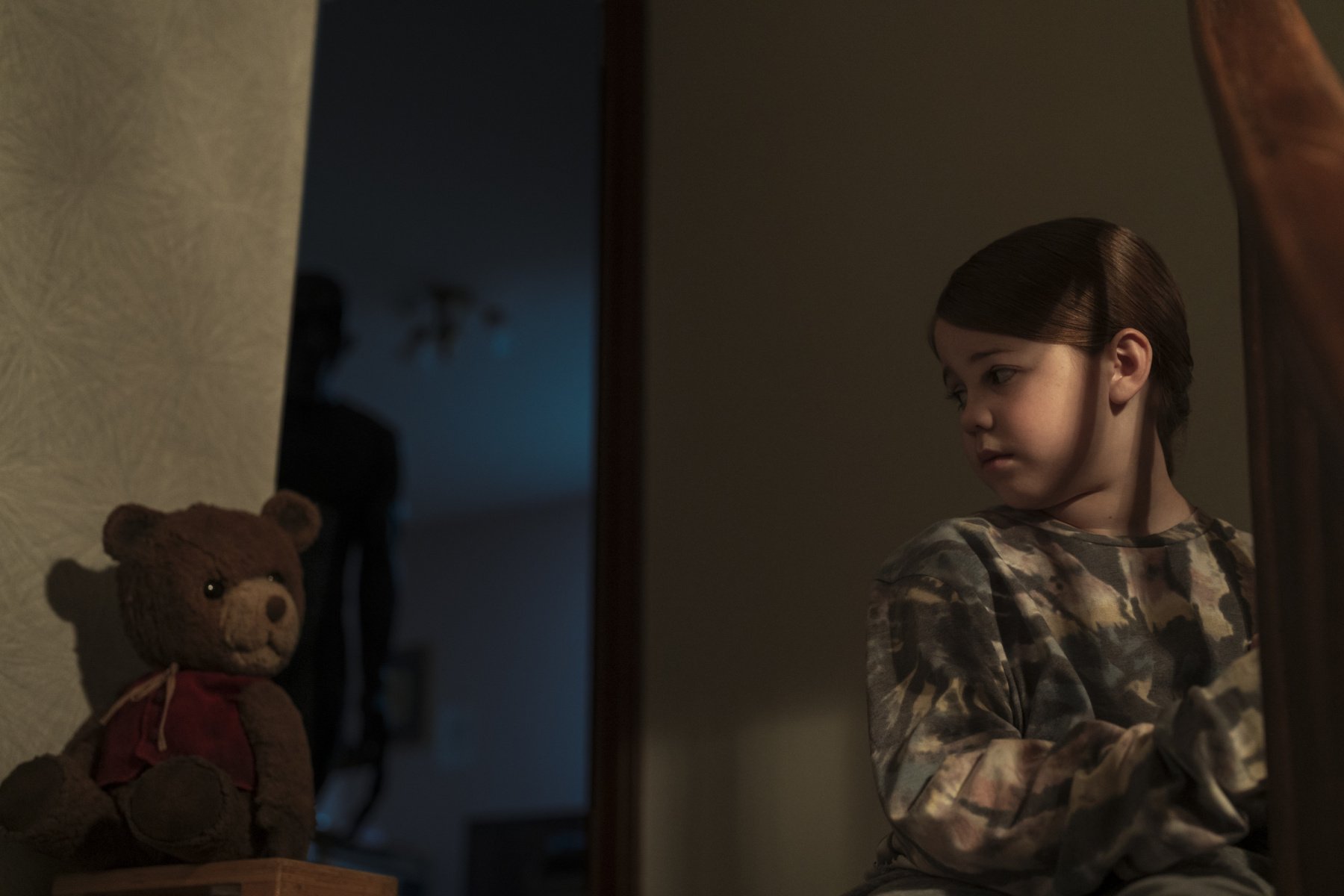
Imaginary follows a familiar formula in its premise and set up. It opens with a family moving into their new house for a fresh start, only to be terrorized by the home’s dark past. There’s a nosey neighbor who appears to deliver a foreboding message about how she’s seen this all happen before. And of course, a creepy child who is enamored by a seemingly innocuous object, here a teddy bear, that turns out to be haunted. It has all of the elements of a standard haunted house film, but the twist here is that the supernatural being is an imaginary friend instead of a ghost or demon. Well, sort of, it is also very much a spirit of some kind. As the kooky neighbor Gloria describes it, there are entities that form attachments to children, most of them benevolent, and they feed off of their creativity and imagination. Those beings live in another realm, an imaginary land, where they can manipulate reality and provide children with their wildest dreams. Despite trying to differentiate itself, the story is not unique among the hundreds of hauntings to come before it. Worse yet, it does not even deliver the expected ghostly scares in an effective and thrilling way.

This is partially due to the film’s flat characters and poor performances that limit the already tenuous believability of the script. Each of the film’s main characters are paper thin cut outs that deliver one predictable line of dialogue after another. In addition to DeWanda Wise’s bewildered protagonist, Jessica, there’s Taylor the snarky teenager at odds with her, always angry and rude, the skeptic that casts doubt on her. There’s Alice, the unnerving little girl who becomes entranced by Chauncey, delivering bland foreboding lines that telegraph the film’s climax again and again. Gloria, Jessica’s old babysitter, who holds the key to understanding her past. As the believer whose life fell apart after no one took her supernatural research seriously, she is responsible for dispensing the film’s explanation for Chauncey’s existence and how it connects to Jessica.
All of these characters function in service of moving the pieces from one scene to another, but don’t feel like a real family the audience should care about. This is most egregious with Jessica’s husband, Max, who is the father to Alice and Taylor. Max is heavily featured in act one and nowhere to be found in the rest of the script, because his sole purpose in the story is to provide exposition dumps for Jessica’s past with lines that are all like, “Are you having the same nightmare you’ve been having since you were five?” Once the story ramps up, Max leaves for his band’s touring gig, abandoning his new wife and two daughters, leaving them to fight off the monster on their own for the remaining hour or so. It is as if the writers realized how one dimensional this character is, even compared to the rest of the cast, and devised a way to get him out of the movie as quickly as possible.

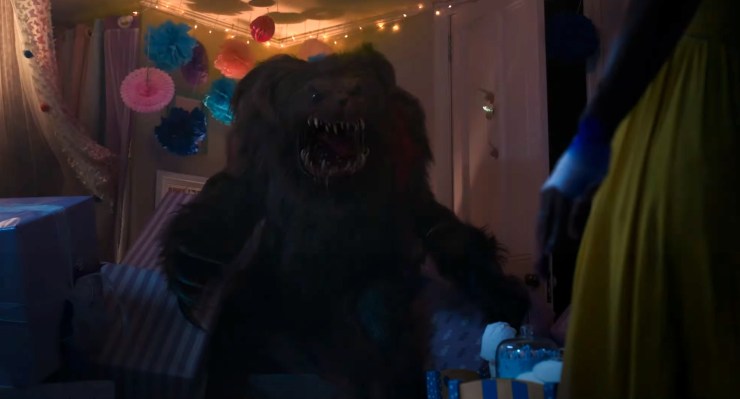
The film finally hits its stride in the climatic final act where Jessica must enter the imagination world, rescue Alice, and defeat Chauncey once and for all. The world of imagination is a blue, hazy series of hallways with thousands of doors that contain various realities. There’s a heavy M.C. Escher influence here with checkered floors and paradoxical staircases to nowhere. All of it feels atmospheric and actually dangerous, especially when compared to the lame jumpscares that took place in the family’s home. This section made me wish we had arrived here sooner in the script, as the possibilities for effective scares are only limited by one’s imagination. However, when we are finally confronted with the “real” Chauncey, or at least the form he has chosen, the horror is completely defused. This is one of the worst creature designs I have seen in a horror movie. A somewhat deranged looking mascot bear whose clumsy movements turn it from an imposing threat to an object of ridicule. In a world where Chauncey could be anything, why is he a man in a bear costume?
Imaginary fails to deliver an emotionally resonant story because the audience is never given a reason why we should care about this family. The scares do not work because we don’t fear for their lives in the same way we might if we were offered more of their interior world. The inevitable defeat of the monster through the power of Jessica’s love for her new family is sweet, but ultimately hollow too. Ironically, it is Imaginary’s lack of creativity that hinders what could potentially be the next franchise for Blumhouse. There is just very little about this stale haunted house story that is successful or original or worthy of your attention.



 Reel Take
Leave a comment