
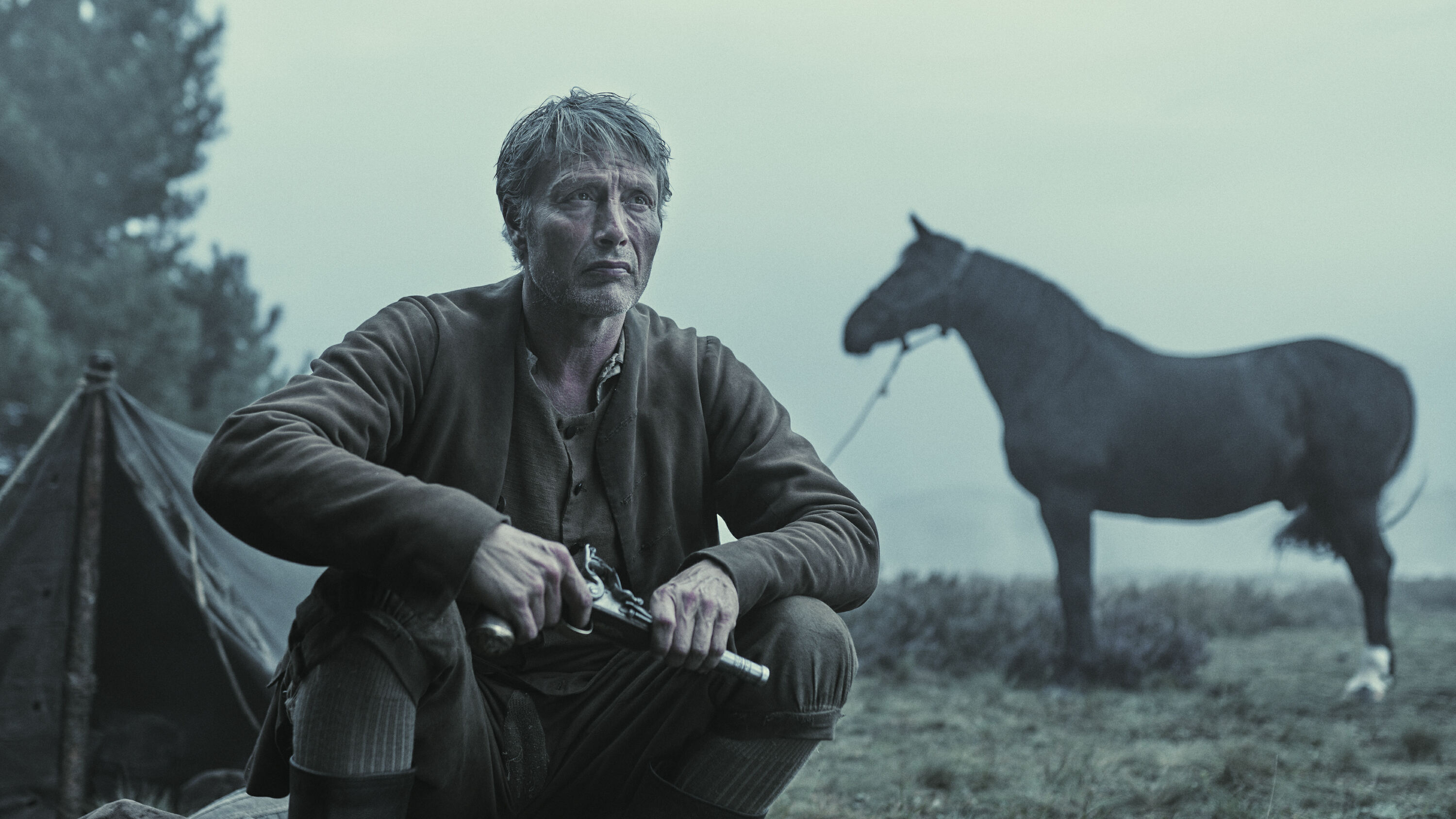
The Promised Land is a historical epic about one man’s quest to lay claim to the untamed and barren wilds of Denmark’s Jutland Heath. It is directed by Nikolaj Arcel and first premiered at Venice Film Festival in August 2023 where it was nominated for Best Film. It was submitted as the official Danish selection for Best International Film at the 96th Academy Awards, where it made the shortlist of the fifteen finalist nominees. The film stars Mads Mikkelsen as retired captain Ludvig von Kahlen, who sets out to cultivate the unclaimed Danish brushland in order to receive a nobility title from the king for his efforts. When Kahlen arrives he is confronted by Frederik de Schinkel, a magistrate and nearby landowner who has already claimed the land surrounding his manor and will do everything in his power to thwart Kahlen’s plans for the heath.

Mikkelsen gives a solemn performance as Captain Kahlen, the bastard son of a distinguished Danish noble. Kahlen is tormented by the circumstances of his birth, desperate to prove himself to the king and the upper class. The royal court grants Kahlen permission to build a settlement and lay claim to the scruff and dry wilderness. He takes this duty incredibly seriously because he believes if he is able to cultivate food in these barren lands, the king will grant him a noble title. This single-minded ambition is a clear character flaw in Kahlen, that slowly overcomes him during the course of the film. He hires laborers to assist with the farmwork, including a group of Romani travelers and a married couple, Johannes and Ann Barbara, who have recently escaped from the sadistic nobleman de Schinkel. In their first meeting, de Schinkel warns Kahlen that life is chaos and finding meaning and order amongst the wilderness is a fool’s errand. Despite his consistent warnings to cease the cultivation of his land, Kahlen ignores him, believing the king’s law to be on his side. The enraged nobleman kidnaps Johannes in response and makes an example of him, pouring buckets of boiling water on him until he dies.

When Kahlen returns to the settlement, Ann Barbara is devastated by the loss of her husband and the other laborers decide it is not worth the risk to continue working. Ann Barbara lashes out against Kahlen’s selfishness and lack of compassion for her loss. This is the first time in the film where he is forced to reconsider if his goals are worth it considering the now life and death stakes. His single mindedness, blind ambition, and willingness to sacrifice his workers suggest that, although not murderous, Kahlen is not too different from de Schinkel. However, witnessing the lengths in which the nobleman is willing to go to remain in control of the heath only reaffirms his desire. He still believes that gaining nobility is the only way he can fight back against the upper class therefore giving up is not an option. Kahlen begs a reluctant Ann Barbara to stay through the winter with him and a romance begins to blossom. The Romani travelers leave behind a young girl, Anmai Mus, played by the charming and spunky Melina Hagberg, who remains in their care. The three form an unlikely family. The child’s dark skin subjects her to bigotry and fear, even among the other Romani people. This highlights the structural barriers that exist even within the lower class and the limitations of gaining liberation through rising in social class.

Denmark’s dry heath landscape offers a sense of opportunity for the common people. It is symbolic of the democratization of power through land ownership and the untapped future of the country. Like the film’s title, it represents hope and the freedom for people to live out from under the thumb of the noble class, but this optimism is misguided. After Kahlen’s first successful harvest, the king celebrates by sending him additional German settlers and more farming resources. In retaliation, de Schinkel recruits the neighboring landowners to rally together and end Kahlen’s efforts once and for all, agreeing to split the land between them. The ruling class’s ability to coalesce and act in solidarity despite their differences is a real and present danger nearly three centuries later. Gone is the era of kings and nobles, but the wealth gap between the poor and billionaire class continues to grow. This is compounded by a lack of worker protections and human rights throughout the world and accountability for the ultra wealthy’s violations of these rights. It is a warning that the ruling class will do whatever they can to retain their power.

The Promised Land is critical of the illusion that one just has to persevere long enough and they can increase their social standing. This is a narrative that keeps working people down and provides them with a false sense of hope. When Kahlen finally accepts that his desire to achieve the social status denied to him at birth is a futile effort, he recognizes the importance of the relationships he’s formed along the way. He finally sheds his arrogance and reconciles that dreams achieved at any cost will cause him to lose everything important in the process. The Promised Land ends with the feeling that life is chaotic and unpredictable, and to be rigid and unwavering in your pursuit of external validation is to resign yourself to the whims and destruction of those forces.



 Reel Take
Leave a comment