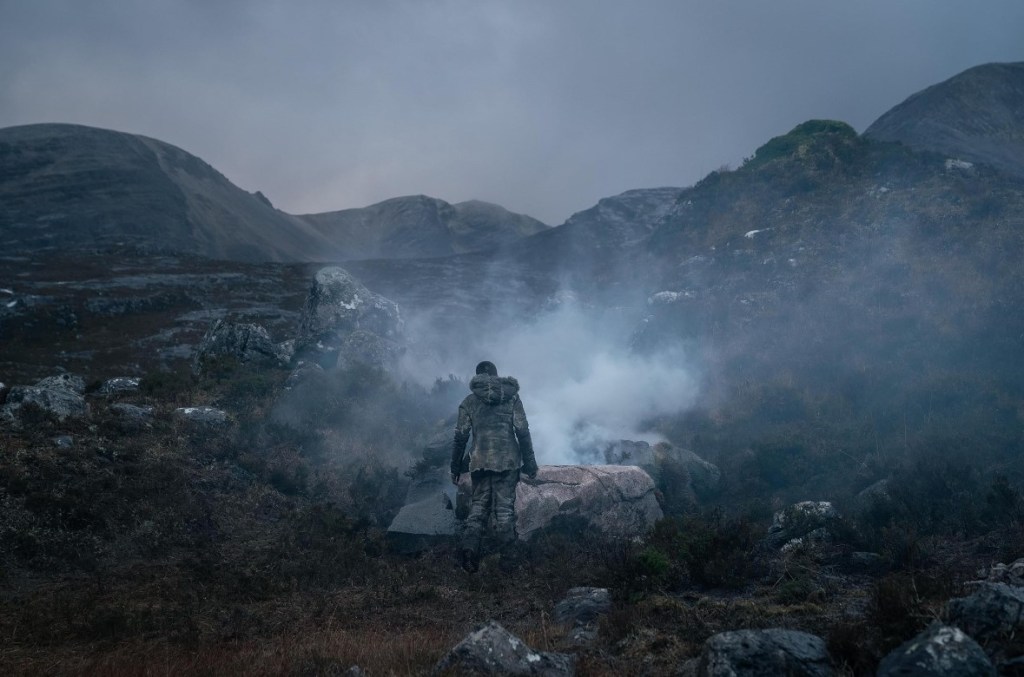
Out of Darkness is a stone age survival horror film about one tribe’s journey to establish roots in a mysterious and dangerous new land. It’s the debut feature film of director Andrew Cumming and script writer Ruth Greenberg, premiering at the BFI London Film Festival in October 2022 under the name The Origin. It later premiered in Scotland at Glasgow Film Festival 2023 before Bleecker Street acquired the American distribution rights. The reason for Bleecker Street’s decision to rename the project is unknown, speculation suggests that it was done to avoid confusion with DuVernay’s Origin which had a theatrical release just a few weeks ahead of the caveman thriller. Out of Darkness is a more fitting and engaging title for the project as it emphasizes early man’s struggle to build civilization out of the untamed natural world.

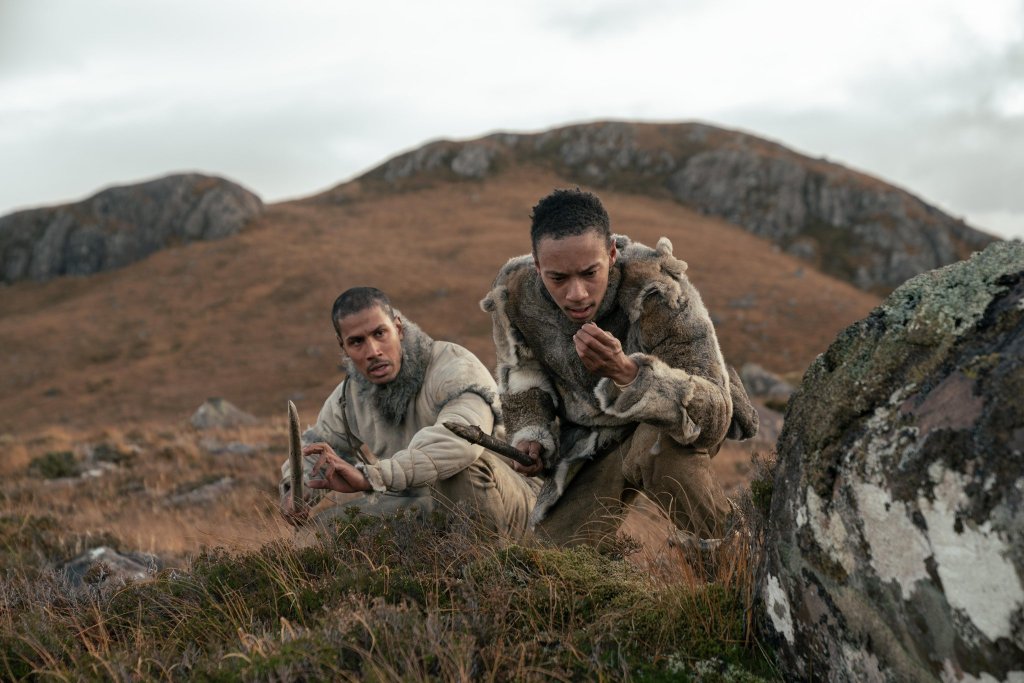
The film is set 45,000 years ago and follows a group of six nomadic people exploring an uncharted tundra landscape. Beyah, played by Safia Oakley-Green, is an outsider to this family unit and must prove herself as a worthy member of their tribe. When the group arrives in this new world, they are starving and left exposed to the elements. Adem, the leader of the tribe, struggles to find food out in the tundra wastes which takes a toll on his son Heron and Ave who is pregnant with his child. One night, while gathered around the campfire, Heron is snatched away into the darkness by unknown forces. Adem, fuelled by desperation, leads the group deep into the forest where they set out to confront this lethal entity. The group’s dynamic is upset by conflicting opinions on what this being could be: Animal? Man? Demon? Nevermind the challenge of catching and killing it. This causes suspicions among the group, spiraling into baseless accusations lobbed at one another. Adem’s single mindedness in rescuing his son puts the entire tribe in danger as the sun begins to set once more.
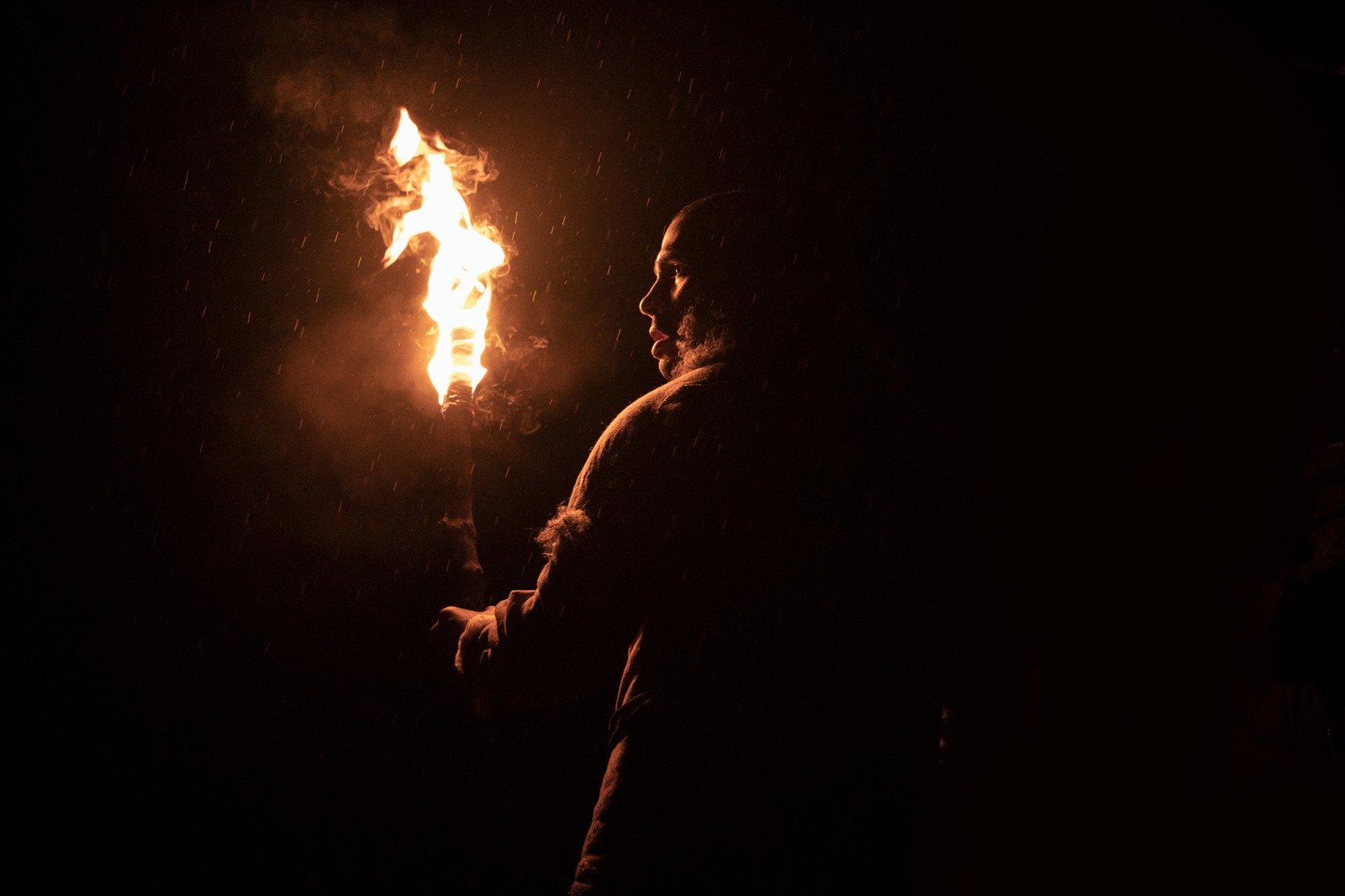
Most horror movies target and exploit our primal fears to achieve their onscreen scares. This film takes it a step further by sending the audience back to that time in human history. A time when having a healthy fear of the dark could spare you from getting eaten by a stealthy predator. As in its namesake, Out of Darkness relies on this fear more than anything else to drive a sense of mystery and dread in the audience. The orange glow of the campfire is often the only source of light in these scenes, the pitch black abyss shrouding everything just outside their basecamp. It is especially effective when viewed in a movie theater, the flicker of the flame intermittently illuminates portions of the auditorium, enhancing the sense that we are also sitting in the dark with the tribe. At times it had me looking over my shoulder to make sure there weren’t any saber tooth cats lurking within the theater crowd, not an easy feat for any horror movie.
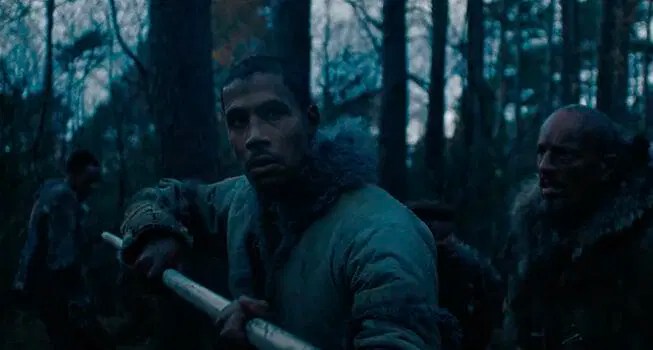
The second act of the film is where these elements shine and consistently deliver on what the movie poster is selling. As night falls on the forest, the crew frantically attempts to start a fire in order to ward off the rapidly approaching creature. This scene excels at delivering suspense, a testament to both the editors and onscreen performances. The sparks of flint light up small portions of the woods, giving us glimpses into the treeline. The group tightens up their circle as the shrieking sounds get louder and closer, not knowing which direction it is coming from. The quick cuts from each of the perspectives causes the audience to “see things” that may not actually be there, exposing our own limitations in a survival setting.
It all works really well and creates a thrilling experience, allowing the audience’s mind to race with possibilities. That is until the nature of this creature is finally revealed. By the end of that first night, half of the tribe is killed in a brutal fashion. Just when it is clear that our hero, Beyah, is outmatched, the film finally unveils the monster, completely deflating all of that sustained suspense in the process. Yes, the being is still a major threat, but not knowing what kind of threat is what pushed the first half into true horror. The final act as a result is more concerned with explaining and tying up loose ends than it is continuing at the same pace.

This is a disappointing and convoluted ending to an otherwise straightforward and effective premise. Without spoiling the film’s two major reveals, the second half of the movie feels distinctly different, never fully achieving the same tension as when things were left unknown. Applying this newfound knowledge retroactively inspires more questions than satisfying answers when it comes to the creature’s reason for stalking them. It feels like the safest decision was made when answering the question, “what is it?” Sure, fine. The question, “how did it kill them all?” requires a healthy amount of suspension of disbelief, but it works. However, in trying to answer the more compelling question of “why?”, the film twists itself in knots trying to justify some moral motivation for the carnage unleashed on these nomads.
It ends with the feeling that because Beyah’s victory comes with significant bloodshed, she is also a monster and perhaps an even worse one. The suggestion then becomes more sinister as it seems like Out of Darkness is saying that the success of our species hinges on self-determination through violence, both then and now. It is a chilling observation that stuck with me long after leaving the theater. Out of Darkness succeeds as a horror story that transcends thousands of years of human history, exposing our instinctual drive to eat or be eaten. However it’s a bit primitive when it comes to delivering a coherent reflection on human nature and our propensity for violence.

 Reel Take
Leave a comment