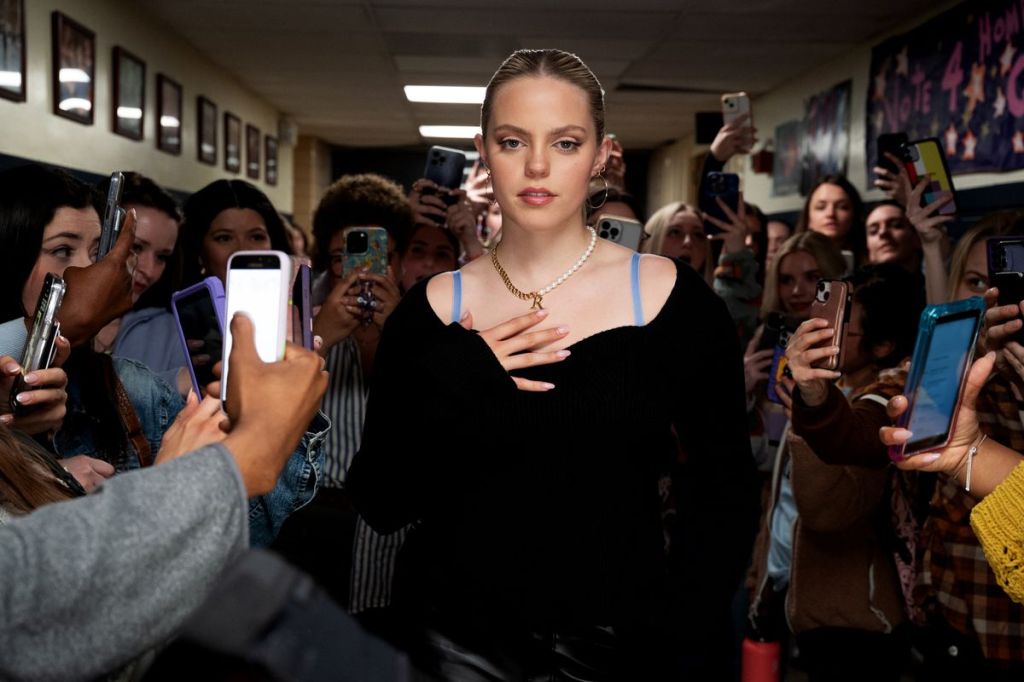
Mean Girls is a musical comedy reimagining of the now twenty year old cult classic movie from Tina Fey. The film is directed by Samantha Jayne and Arturo Perez Jr. and is an adaptation of the stage musical which first premiered on Broadway in 2018. The musical borrows all of the major plot elements from the original movie, while updating it for a modern audience. There are 21 tracks within the Broadway show, which is narrowed down to just 12 for the 2024 screen adaptation. The musical debuted with mixed reception, with many critics praising Fey’s punchy comedic style, but noting that the score and particularly the lyrics left a lot to be desired. Renee Rapp stars as Regina George in the 2024 adaptation, a role she previously played on Broadway. Rapp is joined by Angourie Rice, playing new girl, Cady Heron, and Auli’l Cravalho, of Moana fame, playing vengeful art student, Janice ‘Imi’ike.

One of the major changes from screen to stage (and back to screen) is apparent in the opening number, “A Cautionary Tale”, where Janice and her gay best friend Damien, Jaquel Spivey, share the role of narrator. The 2004 movie is told entirely from Cady Heron’s point of view as she navigates her transition from homeschooled in the plains of Kenya to the social hierarchy of American high school. Cady’s voiceover frequently comments on the similarities between the law of the jungle and “girl world”, marking her slow descent into the world of pettiness and rumors. While this adaptation still has Cady’s story front and center, she plays a much less active role in the events of the film.
It was always ultimately Janice’s plot for revenge against Regina, but 2004 Cady seems to relish this opportunity in a way that the new adaptation hesitates to. Rice gives a fun and sweet introduction to the character with “What Ifs” and her motivation is clearly spelled out in “Stupid With Love”. She nails the starry-eyed, innocent fish out of water aspect of the character, but her transition to “mean girl” is just not believable at all. This is partially because we spend less time with her and the Plastics early on, and don’t get to see Cady slowly get corrupted by their influence. The film barrels towards the pivotal Halloween scene and at last introduces some conflict for Cady. She witnesses Regina toying with her crush Aaron in front of her and is finally motivated to take action against her. It is hard not to draw comparison to Lindsay Lohan who originated the role. Lohan has such star power and onscreen charisma that there’s no doubt that Mean Girls (2004) is her film. Whereas Rice just seems like she’s along for the ride that Cravalho and Rapp have set up for her, losing a lot of her agency and what makes Cady a compelling character.
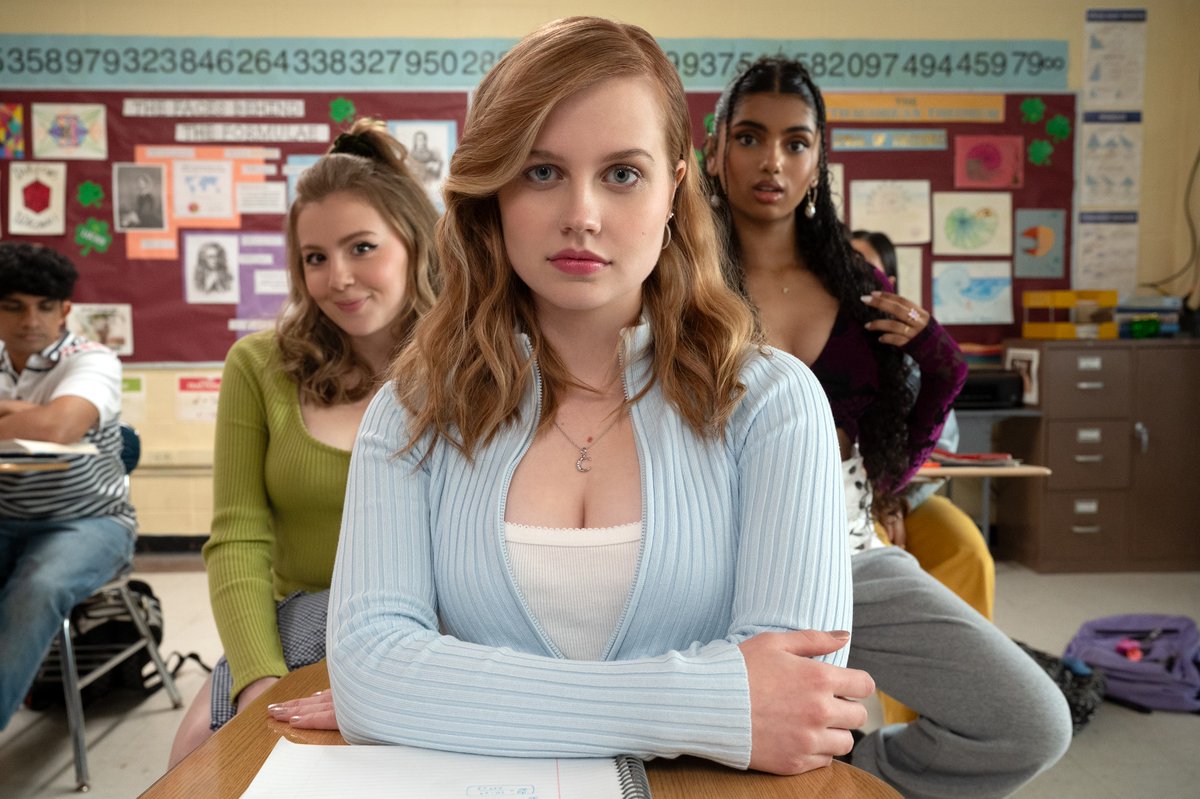
The initial Broadway run of Mean Girls faced criticism for its childish lyrics and inconsistent music stylings, noting them as the weakest aspect of the stage show. An example from the much maligned song “Revenge Party”: “It’s a revenge party, With your two best friends. It’s like a party with revenge, that’s what it’s like.” Little has been done to update the lyrics themselves, aside from a rhyme scheme adjustment here or there, but the music itself has gone through a complete overhaul. Theatre fans may be disappointed to learn that their favorite tracks from the show have been updated with thumping bass lines and pop melodies to mixed results. “Apex Predator”, a standout song from both adaptations, replaced its piano intro and guitar licks with an uptempo dance beat, full of lion roars, and the occasional screech of an eagle. These new interpretations of the musical’s songs are fun and dynamic, and more accessible to the average audience member than showtunes.

Live theatre is something most do not have the opportunity to experience, if not for lack of interest, the cost of tickets alone can be enough of a barrier. Mean Girls (2024) excels in bringing that experience on a smaller scale, exposing more people to musical theatre. The staging and choreography of these musical numbers was the absolute highlight of the film, and arguably the only aspect that justifies its existence. “Sexy” arrives at about halfway through the movie, exactly as the energy begins to dip. The song is a delight to watch not only because of Avantika’s infectious onscreen presence as the ditzy Karen, but because of how well the movie musical medium is utilized. This goes for many of the numbers, but is most obvious here as the audience is taken on one continuous tracking shot, weaving in and out of party goers, closely following Karen. This may go unappreciated by the average viewer, but these shots go a long way in making these performances engaging, avoiding what could’ve been endless amounts of bland shots of performers singing directly into the camera. I can’t mention the music without acknowledging that Renee Rapp completely crushes both of her solos, “Someone Gets Hurts” and “World Burn”. Rapp is a vocal powerhouse, it is difficult to imagine another performer nailing the ferocity of these songs with such ease.

What Mean Girls really suffers from is an identity crisis. To be clear, there are several welcome changes to the 2000s comedy that have not aged well and were due for an update. A few examples include the original’s treatment of Asian characters, the casual use of homophobic slurs, and a teacher accused of sleeping with students which is played for laughs. However, somewhere in the process of sanding down these rough spots, the adaptation completely loses its edge. Twenty years ago, evil took human form in Regina George, but now that evil has been reduced to something closer to a nasty internet comment. Kinda rude with a bad attitude does not a mean girl make. In an effort to appear as inoffensive as possible, it’s like they completely forgot that these girls are supposed to be, well, mean. It doesn’t help that most of Regina’s characterization happens in song, through other student’s perception of her or her own self proclamations, rather than actually seeing her bully and harass her classmates.

Additionally, Janice’s character has gone through significant changes in this retelling. For one, she is openly a lesbian in this film, an improvement over the original’s lame “Lebanese” joke and shoehorning a male love interest in the final minutes. But in this character’s reimagining, she too has lost everything that makes Janice an interesting and mean character. She’s now the de facto narrator, who does little more than carry the film’s half-hearted anti-bullying message, and as such needs to be the antithesis of Regina. It is somewhat brushed under the rug that Janice is the one who orchestrated the take down of Regina, with her song “I’d Rather Be Me”. The song proclaims that Janice does not care what the popular kids think of her nor will she stoop to their level when that just simply isn’t true.
Janice plotting revenge against Regina for something that happened in eighth grade and using Cady as a means to get back at her is conveniently unaddressed to neatly wrap up the story line with an “inspirational” anti-bullying anthem. I’m reminded of the iconic line from Mean Girls (2004) where Janice calls out Cady, “See at least Regina and I know we’re mean. You try to act so innocent like, ‘Oh, I use to live in Africa with all the little birdies, and the little monkeys!’” The original is unafraid to show that Regina is far from the only mean girl in school, that it isn’t as simple as mean and nice because of how young girls have been socialized to relate to one another. That is the piece that’s missing most from Mean Girls (2024).

The film never really succeeds at justifying why someone would choose to watch this version of the endlessly quotable comedy from 2004. The inclusion of iconic lines and moments from the original at best provoke a smile out of recognition and at worst feel like listening to a friend rattle off quotes during a watch party. While containing the occasional cringeworthy lyric, the musical numbers are exciting, dynamic, and I look forward to rewatches for that alone, even if I choose to treat them like individual music videos. Every performer gives it their absolute all, Rapp and Cravalho especially, their passion for the original is clearly evident on screen. However, in updating the story for a modern audience, Mean Girls loses a lot of the mean-spirited edge that allowed the original film to transcend to pop culture greatness. Cynically, it is hard not to view this film as just an attempt to profit off of an active fan base, two decades after the fact. And why adapt the musical, which wasn’t exactly popular in its own right? It is easy to imagine the conversation between Tina Fey and the executives at Paramount as they delicately danced around the dreaded word “reboot” while conceptualizing this film. Mean Girls is a pale imitation of its beloved source material, but overall is still a revenge party worth attending.



 Reel Take
Leave a comment