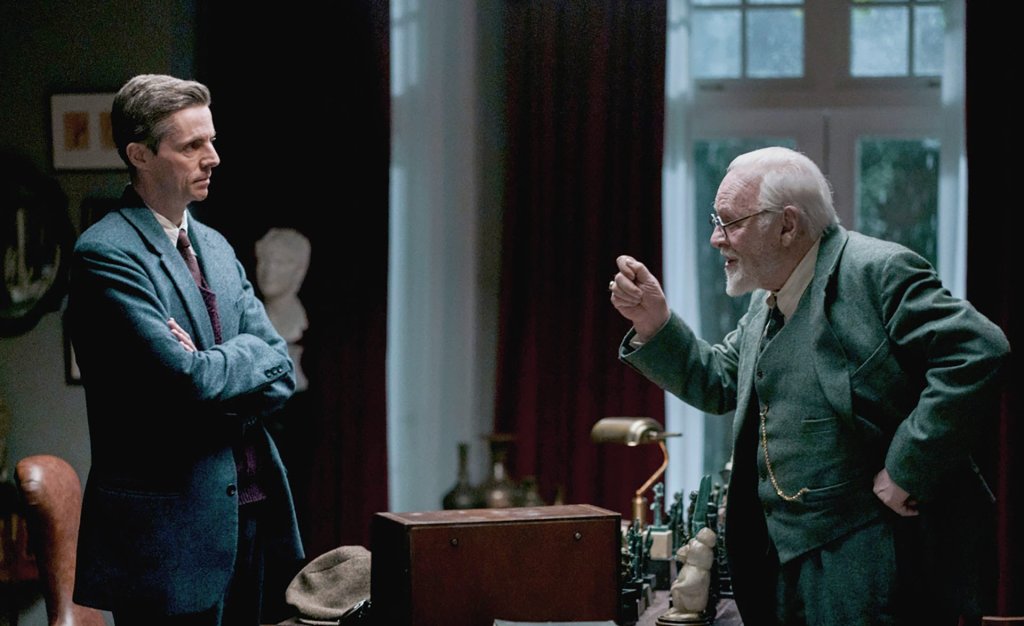
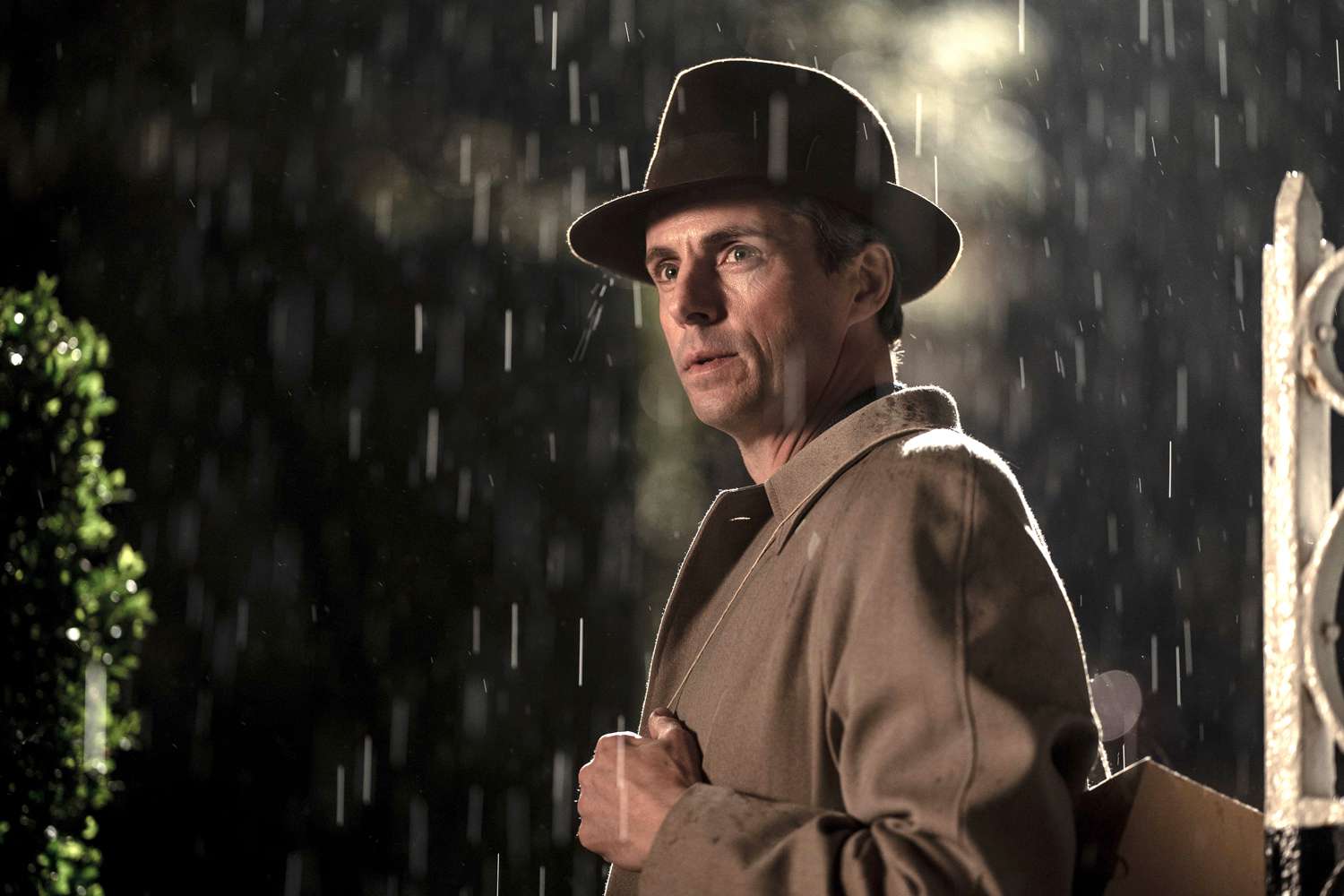
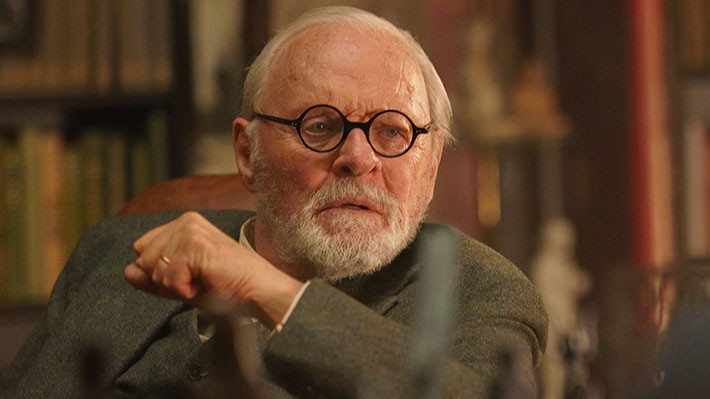
Freud’s Last Session is an intimate look into the final days of the famed pioneer of psychoanalysis as he grapples with his own mortality and the very existence of God. The film is directed by Matthew Brown who’s previous work, The Man Who Knew Infinity, similarly follows the life of an influential academic. Freud’s Last Session was adapted from a stage play of the same name, both were written by playwright Mark St. Germain. The play debuted in 2009, eventually opening in New York where it received critical praise, winning the Best Play Award from the off-Broadway Alliance in 2011. This adaptation stars Anthony Hopkins as an ailing Sigmund Freud, struggling with his inoperable oral cancer. He clashes with a devout C.S. Lewis, played by Matthew Goode, over the importance of faith and its necessity to the human psyche.
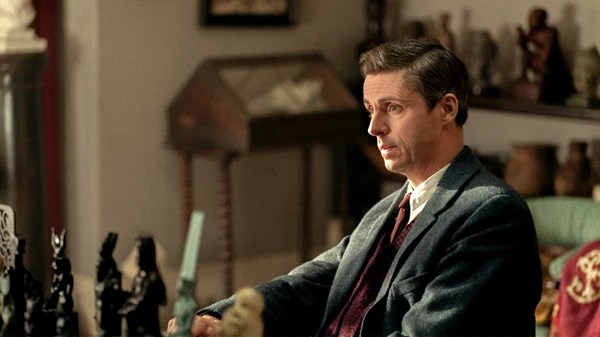
The early days of World War II loom heavily over the entire film, a reminder of humanity’s appetite for destruction and the violence of the modern world. In Freud’s library, he and Lewis, nicknamed “Jack”, engage in a lively debate over Jack’s newfound Christian beliefs. The two are frequently interrupted by new updates over the radio describing the German advancement into Poland. They each approach this religious conversation from their respective fields. Freud uses his understanding of psychology to analyze how all spiritual beliefs across humanity adheres to similar principles. Thus proving that God is an innate coping mechanism developed by humans to rationalize their own existence rather than a being that exists in his own right.
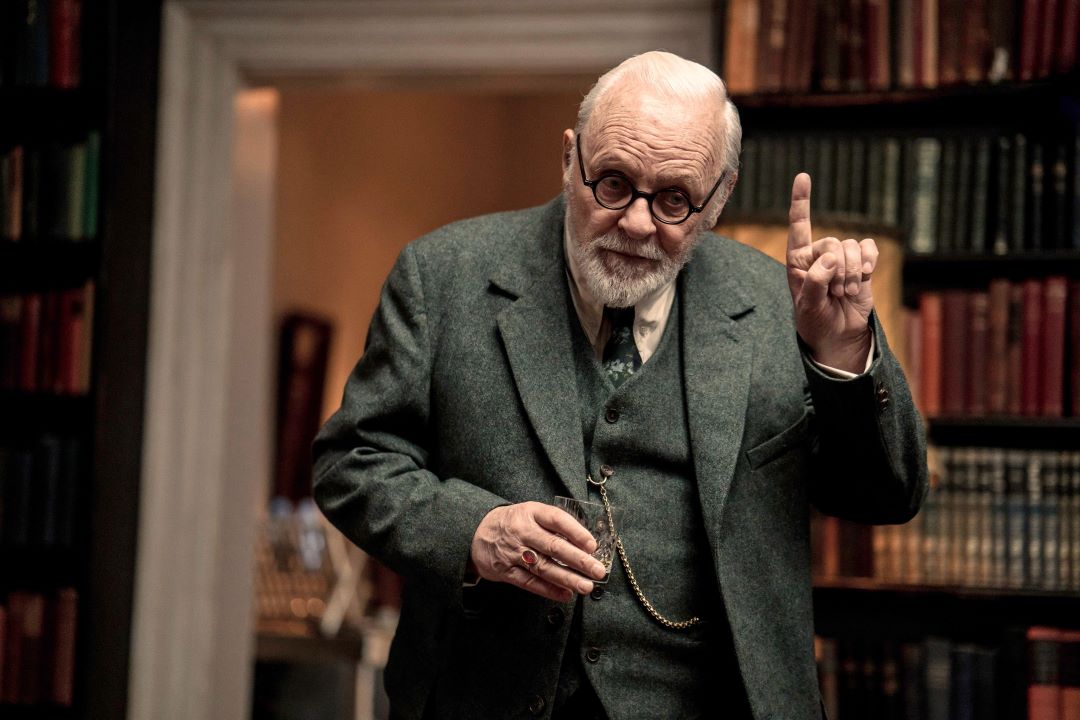
After losing his mother at a young age and being enlisted in World War I, Jack had completely abandoned any belief in God. However, with encouragement from his fellow writers at Oxford, including J.R.R. Tolkien, he engages with the New Testament like a work of literature for the first time. Jack converts late in life and fully embraces Christianity in his works of fiction. Similar to Freud, he believes there’s a universality to religion evident in all works of human creation, however to Jack this collective understanding is proof of God’s existence. Despite the two leads’ best efforts, the conversation that unfolds is trite and uninspiring, offering little in the way of grand revelations. Aside from the occasional jab at the other’s expense, their debate is a bit dull and not as philosophically engaging as the filmmaker hoped it would be. This is a huge problem because a significant portion of the film is just Jack and Freud speaking to one another in a single location. If it were not for Hopkins in the titular role, these scenes would fall completely flat.

Hopkins is a once in a generation talent who is able to completely transform, bringing so much life to the character of Freud. The psychoanalyst has become synonymous with his own field of study, with his popularized theories and words like “Freudian” entering our cultural dialogue. His work in psychology is especially sensationalized because it focuses on the complexity of human sexuality and the subconscious which was incredibly subversive for its time. As a result, the man himself has become mythologized in Western culture, whether you subscribe to his theories or not. Freud’s Last Session peels back the curtain so the audience can learn more about who Freud was as an individual, and see what makes him tick for a change. Hopkins delivers the bombastic arrogance we imagine Freud possessed, but there are layers to his performance that expose him as a hypocrite who’s just as afraid to die as anyone else.
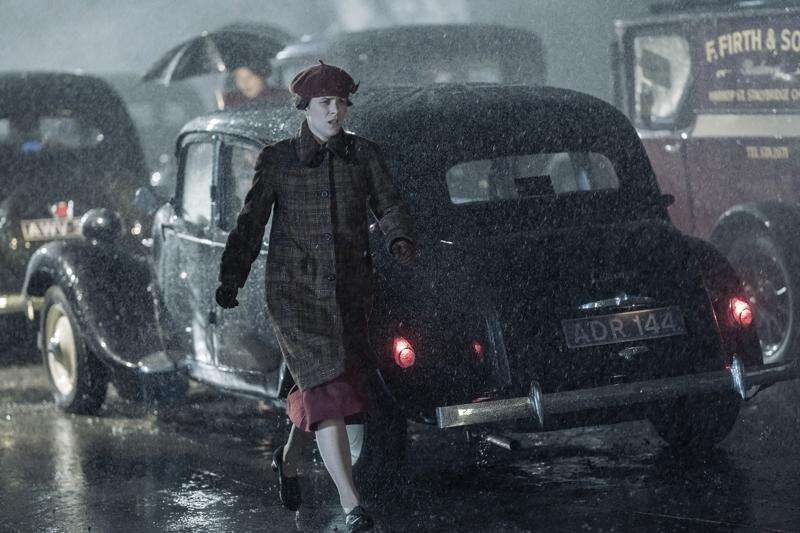
The film uses Freud’s strained relationship with his daughter Anna to solidify this point. Anna is a successful psychoanalyst in her own right who struggles to break free from her father’s influence. She is constantly at his beck and call, completely dependent on him for approval and validation. This is complicated by the fact that she has a same sex relationship with her partner Dorothy, who Freud does not approve of. While speaking to Jack, Freud admonishes him for believing homosexuality is a sin, criticizing his selective use of Bible passages. Although there’s a catch because despite believing same sex attraction to be a natural part of human sexuality, he hesitates to include Anna in this understanding. This is less about a moral objection and more to do with his fear of failing her as a father. Freud’s objection is misogynistic in nature, believing homosexuality in women to be a result of the rejection of their fathers and a larger animosity towards men. This stubbornly held belief is in turn an indictment of himself, which Freud simply cannot allow. Freud’s denial of his daughter’s sexuality complicates his initial portrayal as a disruptor against the prevailing Christian dogma and exposes the hypocrisy within him.
Freud’s Last Session struggles in its translation from stage to screen, never fully recovering from its clunky adaptation. It is a dialogue heavy movie that bombards the audience with exposition and does not allow any question or idea the space it needs to breathe. This is not a problem for a stage play which is primarily a medium for the ears, but makes for an exhausting viewing experience. In an effort to make the film more cinematic, the director includes flashbacks and dream sequences to break up the monotony of Jack and Freud’s debate. These include Jack’s time in World War I, Freud’s diagnosis with oral cancer, and Anna volunteering to assist the Nazis’ research in his place when they attempted to recruit him before fleeing Austria. All of these provide additional color to the two leads, but are utilized so haphazardly that it’s distracting to the audience. There’s one dream sequence that does an okay job at illustrating Freud’s psychological state, but in a film about the father of dream analysis I was expecting something more compelling and visually striking. It’s unfortunate because Hopkins and Goode give excellent performances and Freud is a fascinating figure to deconstruct but it just does not succeed in its adaptation to film. Freud’s Last Session offers us a glimpse of the man who significantly contributed to our understanding of the human mind, but is held back by its strict adherence to the source material.


 Reel Take
Leave a comment